
Where standards end, innovation creates its own solutions. Our exclusive tools then open up new horizons, and both their development and mastery become essential levers for optimization, precision, and customized performance….
Driven by the ambition to go further, Yoctoline conceives each project with precision down to the smallest detail. To achieve this, exclusive digital tools have been developed, designed to support even the most unique ambitions. Unavailable on the market, they reflect a philosophy that rejects compromise providing each vessel essential optimization where technical perfection becomes a discreet luxury.
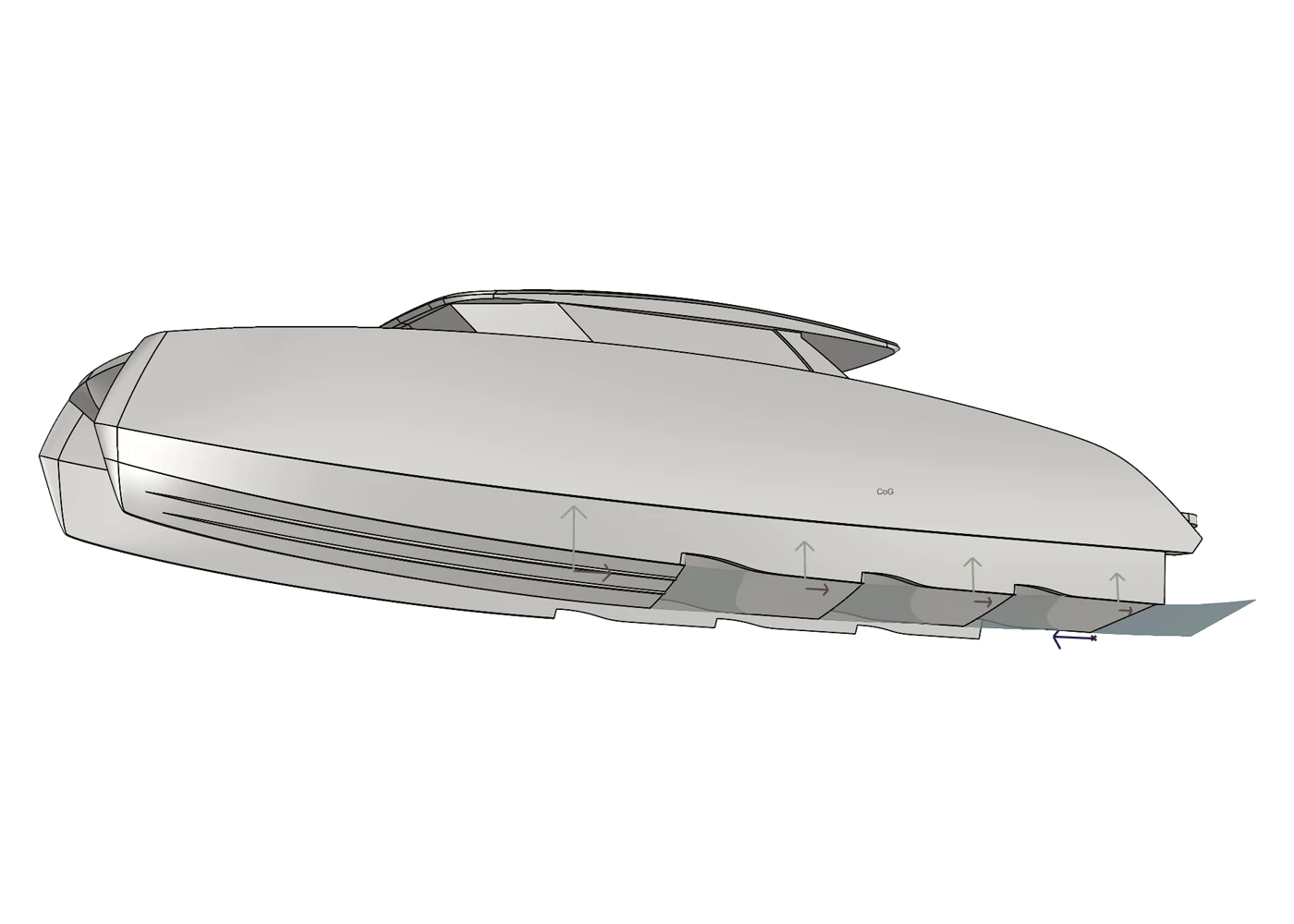
Designing a hull is not complicated in itself. Designing a hull truly optimized for a specific use, however, is a far more demanding challenge. With so many possible configurations, claiming to achieve ‘the’ perfect hull would be unrealistic. But having the ability to test a wide range of configurations brings allows us to get as close as possible to it.
This is precisely the purpose of Flow Designer™: a modular and complementary software suite developed in-house, capable of predicting the behavior and performance of any hull type as well as every appendage that might contribute to it. By directly analyzing the geometry, it becomes possible to test and evaluate the slightest variations, where simplified mathematical models based only on the main dimensions of the ship quickly reach their limits.
Integrating the advanced features of SteppedFlow™ and FoilFlow™, this unified environment adapts to all types of design, for the study of classic or stepped planning hulls, foils, trim tabs or interceptor integration, multi-outboard configurations… Each module can be used independently or combined according to the specific needs of the project.
With its adaptability and processing speed, Flow Designer™ becomes a strategic decision-making tool, anticipating performance, optimizing dynamic stability and precisely controlling the yacht’s behavior. Positioned upstream of CFD, it guides initial directions and pre-validates architectural choices, which are then refined through digital simulation when necessary.
Designed not to replace CFD but to precede it intelligently, Flow Designer™ transforms technical complexity into optimization capability, where every line drawn becomes an informed choice.

When it comes to speed, stepped hulls quickly emerge as a leading reference. Yet designing an efficient stepped hull remains one of the most complex challenges in naval hydrodynamics. To date, there is no standard analytical model capable of fully characterizing this type of geometry, especially given the multitude of possible configurations.
To overcome this limitation, we developed SteppedFlow™, an exclusive module based on physics applied directly to 3D modeling. This innovation predicts flows around the steps with precision, thereby avoiding the need for costly and laborious methods. This tool provides valuable data such as the lift generated by the steps, the overall vessel balance and its hydrodynamic resistance.
This detailed knowledge paves the way for optimizing hull lines, significantly reducing drag and improving stability across all sailing conditions.
Integrated from the earliest sketches, SteppedFlow™ enables the design of faster, better balanced and more efficient hulls, mastering both fuel consumption and dynamic behavior with elegance.

Gliding over water with efficiency and smoothness across the water is no longer reserved for high-performance racing. While foils open up unprecedented possibilities in terms of performance, their design remains a complex exercise, long reserved for the most competitive projects. Predicting hydrodynamic forces, understanding the effect of lift, drag, cavitation or ventilation requires sophisticated tools and a keen understanding.
With its evocative name, FoilFlow Designer™ provides detailed analysis of the behavior of lifting appendages, their loading and efficiency considering target speeds, trim variations, hull configurations and dynamic interactions with the water. Each foil is designed to maximize useful lift, minimize parasitic drag and ensure controlled stability, even at high speeds or in varying sea conditions.
More than just a simulation tool, FoilFlow Designer™ is a strategic design tool that allows integrating foils from the earliest stages of the overall design for optimal efficiency and consistent architecture.
A cutting-edge tool created to integrate modern design requirements and amplify the potential of the most visionary projects.
Propulsion for a yacht is not simply a matter of mechanics. It is a subtle alchemy, where the ship’s resistance, the hull’s efficiency, the engine, the propeller, the transmission and every intermediate component must interact perfectly. An imperfect balance leads to overconsumption, performance losses and reduced autonomy.
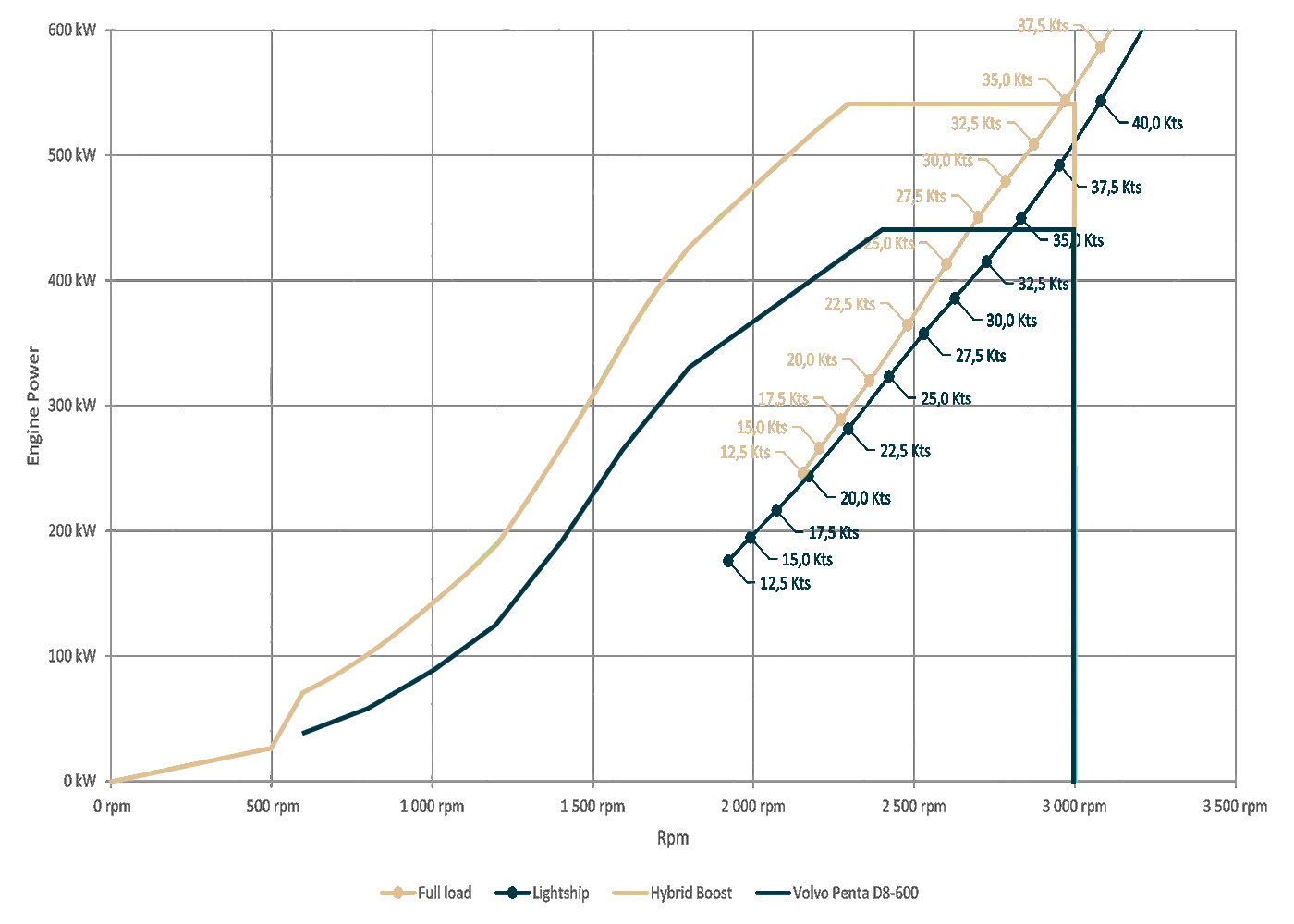
It was in response to this complex equation that MarineThrust Analyzer™ was created. Initially developed as a calculation tool dedicated to propellers, it evolved through projects and requirements to become a true decision-making engineering tool designed to orchestrate the entire propulsion system. Today, it allows the conception and sizing of complete architectures, whether thermal, electric or hybrid, by adjusting each component with unmatched precision including engine, gearbox, shaft line and propeller.
Its strength lies in its ability to compare the ship’s resistance curve with all possible configurations to identify the most efficient scenario. It evaluates expected performance, calculates global efficiency, identifies mechanical losses, anticipates cavitation risks and even predicts acoustic disturbances.
With MarineThrust Analyzer™, propulsion becomes a real optimization field. More than an engineering tool, it is a promise: smoother navigation, more respectful, and more efficient navigation. A fusion of technology and excellence, designed for the yachts of today and tomorrow.
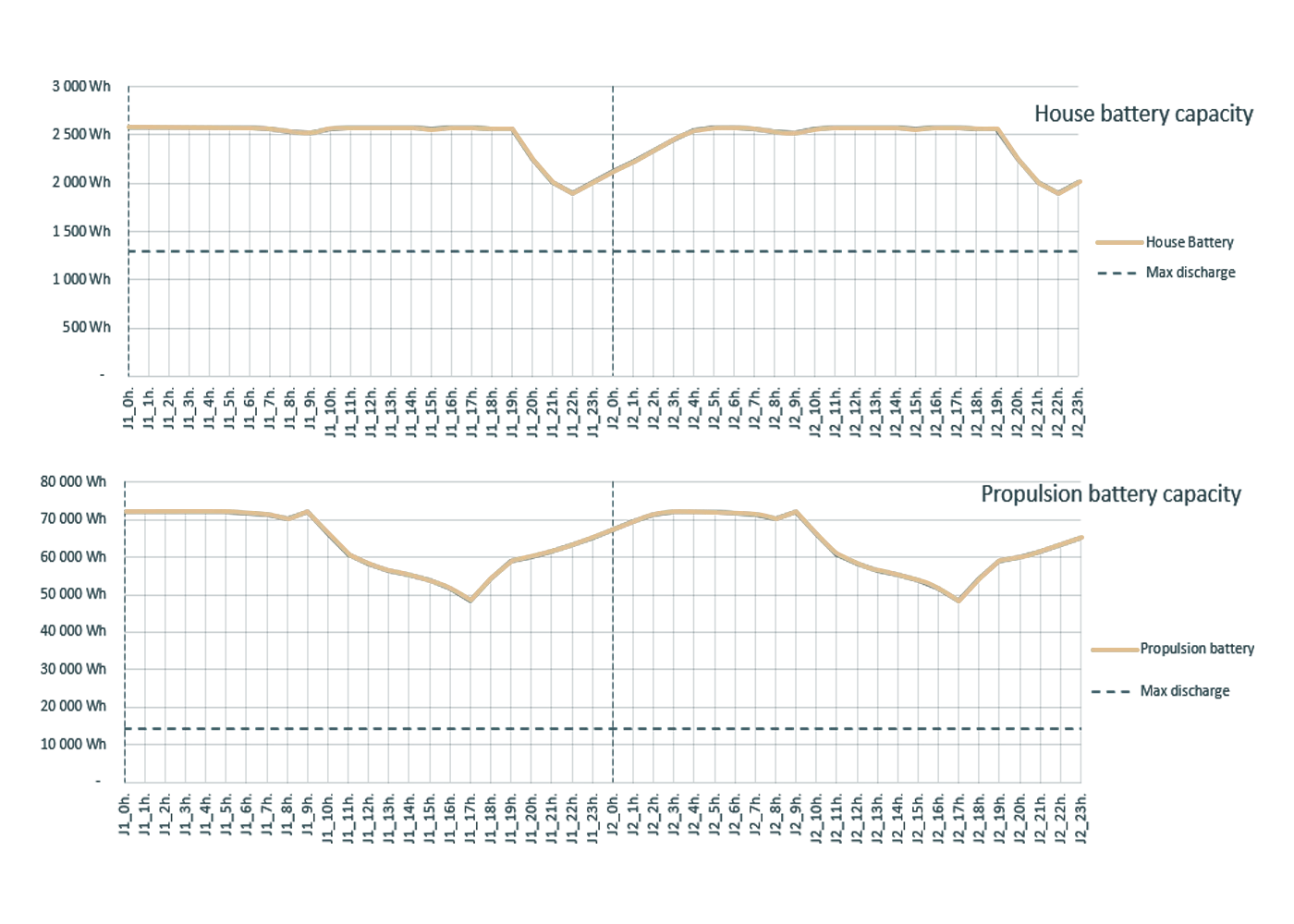
Unlike a building, a boat is a complex closed system that must efficiently manage all onboard resources and energy it carries on board. Electrical management, now the main source of domestic energy, plays a central role in this balance. Understanding how electricity is produced, stored and consumed becomes essential, particularly for hybrid or electric propulsion units, whose needs add significantly to the overall energy consumption balance.
Relating actual energy consumption to the overall performance of equipment is the challenge that EnerVision™ allows us to raise. This tool replicates the behavior and logic of electrical components to simulate usage over days, based on usage and available energy sources on board, such as solar panels, batteries, generators, etc. Aligned with the owner’s habits, navigation profiles and operational constraints, EnerVision™ optimizes energy management to ensure efficiency and sustainability. Whether it is an exploration yacht or a ship seeking solar autonomy, every watt matters. The slightest imbalance between production and consumption can compromise comfort, reduce autonomy or affect reliability.
A major challenge in the current context of energy transition, where hybrid and electric propulsion systems require precise coordination of resources to ensure performance, serenity and respect for the marine environment.